5.1 What Are Life Processes?
- How we identify living organisms: Visible movements (running, chewing cud, growth in plants) and breathing are common signs of life, but even when an organism is asleep or not visibly moving, invisible molecular movements continue inside cells.
- Why molecular movement is essential: Living organisms have well-organised structures (tissues $\to$ cells $\to$ smaller cellular components). Because environmental effects constantly tend to break down this order, living creatures must keep repairing and maintaining their structures by moving molecules around continuously.
- Viruses controversy: Viruses do not show any molecular movement until they infect a host cell—which is why there is debate over whether they are truly alive or not.
- Definition of Life Processes: The maintenance functions of living organisms that must go on even when they are just sitting or asleep—the processes which together perform this maintenance job are called life processes.
The Four Essential Life Processes
- Nutrition: Transferring a source of energy (food) from outside the body of the organism to the inside. Most food sources are carbon-based, because life on Earth depends on carbon-based molecules.
- Respiration: The process of acquiring oxygen from outside the body and using it in the break-down of food sources (via oxidising–reducing reactions) for cellular needs.
- Transportation: Carrying food and oxygen from the place of intake to all body cells, and carrying waste away from cells to the excretory organs.
- Excretion: Removing harmful chemical by-products generated by cellular reactions from the body.
5.2 Nutrition
Organisms require energy and raw materials even when seemingly inactive (to maintain order, grow, develop, and synthesise proteins). Based on how they obtain food, organisms follow two main modes of nutrition:
- Autotrophs: Organisms that use simple food material obtained from inorganic sources in the form of $\text{CO}_2$ and water (e.g., green plants and some bacteria).
- Heterotrophs: Organisms that utilise complex substances, which must be broken down into simpler ones using biological catalysts called enzymes (e.g., animals and fungi). Heterotrophs depend directly or indirectly on autotrophs.
5.2.1 Autotrophic Nutrition (Photosynthesis)
Carbon and energy requirements of autotrophs are fulfilled by photosynthesis—taking in $\text{CO}_2$ and $\text{H}_2\text{O}$ from outside and converting them into carbohydrates in the presence of sunlight and chlorophyll.
$$6\text{CO}_2 + 12\text{H}_2\text{O} \xrightarrow[\text{Sunlight}]{\text{Chlorophyll}} \text{C}_6\text{H}_{12}\text{O}_6\ (\text{Glucose}) + 6\text{O}_2 + 6\text{H}_2\text{O}$$- Storage of unused carbohydrates: Stored as starch in plants (internal energy reserve) and as glycogen in humans/animals.
- Three main events during photosynthesis:
- Absorption of light energy by chlorophyll (present in green cell organelles called chloroplasts).
- Conversion of light energy to chemical energy and splitting of water molecules into hydrogen and oxygen.
- Reduction of carbon dioxide to carbohydrates.
- Desert plants exception: These steps need not occur immediately one after the other. Desert plants take up $\text{CO}_2$ at night and prepare an intermediate compound, which is acted upon by energy absorbed by chlorophyll during the day (minimising daytime water loss).
- Stomata & Guard Cells (NCERT Fig. 5.3): Tiny pores on the surface of leaves through which massive gaseous exchange ($\text{CO}_2$ in, $\text{O}_2$ out) occurs. Because large amounts of water are also lost through stomata, plants close these pores when $\text{CO}_2$ is not needed. Opening and closing is controlled by guard cells: water flows in $\to$ guard cells swell (turgid) $\to$ pore opens; water flows out $\to$ guard cells shrink (flaccid) $\to$ pore closes.
- Other raw materials from soil: Water (by roots) plus minerals like nitrogen, phosphorus, iron, and magnesium. Nitrogen is essential for synthesising proteins and is taken up as inorganic nitrates or nitrites (or organic compounds prepared by bacteria from atmospheric $\text{N}_2$).
NCERT Activities 5.1 & 5.2 (Photosynthesis Proofs)
- Activity 5.1 (Chlorophyll is essential — Variegated Leaf): Keep a variegated-leaf plant (money plant / croton) in the dark for 3 days (destarching), then in sunlight for 6 hours. Boil leaf in water, then heat in alcohol using a water bath to decolourise, then dip in dilute iodine solution. Only the green patches turn blue-black (starch present), proving chlorophyll is necessary.
- Activity 5.2 ($\text{CO}_2$ is essential — Bell Jar & KOH): Keep two destarched potted plants under sealed bell jars; place a watch-glass containing potassium hydroxide (KOH) beside one plant to absorb $\text{CO}_2$. After 2 hours in sunlight, the plant with KOH shows no starch on the iodine test, proving $\text{CO}_2$ is essential.
5.2.2 Heterotrophic Nutrition
- Saprophytic (External digestion): Break down food material outside the body and then absorb it — e.g., fungi like bread moulds, yeast, and mushrooms.
- Holozoic (Internal digestion): Take in whole material and break it down inside the body — depends on body design and functioning (e.g., deer, lion, humans).
- Parasitic: Derive nutrition from plants or animals without killing them — e.g., Cuscuta (amar-bel), ticks, lice, leeches, and tape-worms.
5.2.3 How Do Organisms Obtain Their Nutrition?
- Amoeba (NCERT Fig. 5.5): Takes in food using temporary finger-like extensions of the cell surface called pseudopodia, which fuse over the food particle to form a food-vacuole. Inside the food-vacuole, complex substances are broken down into simpler ones that diffuse into the cytoplasm. Remaining undigested material moves to the cell surface and is thrown out.
- Paramoecium: Unicellular organism with a definite shape; food is taken in at a specific spot, moved there by the movement of cilia covering the entire cell surface.
5.2.4 Nutrition in Human Beings (Human Alimentary Canal)
The alimentary canal is a long tube extending from the mouth to the anus, with specialised regions and digestive glands (NCERT Fig. 5.6):
| Organ / Gland | Secretion / Enzyme | Exact NCERT Function |
|---|---|---|
| Mouth (Buccal Cavity) & Salivary Glands | Saliva containing Salivary Amylase | Teeth crush food into small uniform particles; saliva wets food for smooth passage; salivary amylase breaks down complex starch $\to$ simple sugar (tested in Activity 5.3 using iodine). |
| Oesophagus (Food-pipe) | No digestive enzyme | Lining muscles contract rhythmically (peristaltic movements) to push food forward into the stomach. |
| Stomach (Gastric Glands) | HCl, Pepsin, Mucus | Muscular walls mix food thoroughly. HCl creates an acidic medium facilitating pepsin (protein-digesting enzyme) and kills germs. Mucus protects the inner stomach lining from HCl under normal conditions. Exit into small intestine is regulated by a sphincter muscle. |
| Small Intestine (Longest part; coiled) | Receives Bile (liver), Pancreatic Juice (pancreas), & Intestinal Juice | Site of complete digestion of carbohydrates, proteins, and fats. Length note: Longer in herbivores (to digest plant cellulose) than in carnivores (meat is easier to digest). |
| Liver & Gall Bladder | Bile Juice & Bile Salts (No enzymes!) | (1) Makes acidic food coming from the stomach alkaline so pancreatic enzymes can act. (2) Bile salts emulsify large fat globules into smaller globules to increase efficiency of enzyme action. |
| Pancreas | Pancreatic Juice (Trypsin & Lipase) | Trypsin digests proteins; lipase breaks down emulsified fats. |
| Walls of Small Intestine | Intestinal Juice + Villi | Enzymes finally convert: Proteins $\to$ Amino acids, Complex carbohydrates $\to$ Glucose, Fats $\to$ Fatty acids + Glycerol. Finger-like villi increase surface area for absorption and are richly supplied with blood vessels. |
| Large Intestine & Anus | Water absorption | Unabsorbed food passes into the large intestine, where its wall absorbs more water. Remaining waste is removed via the anus, regulated by the anal sphincter. |
More to Know! — Dental Caries (Tooth Decay)
Dental caries causes gradual softening of tooth enamel and dentine. Bacteria acting on sugars produce acids that soften or demineralise enamel. Masses of bacterial cells together with food particles stick to teeth to form dental plaque, preventing saliva from reaching the tooth surface to neutralise acid. Brushing teeth after eating removes plaque before acids form; if untreated, microorganisms may invade the pulp, causing inflammation and infection.
5.3 Respiration
Cells break down food (glucose) to release energy for cellular processes. In Activity 5.4, blowing exhaled air into lime water turns it milky much faster than atmospheric air pumped with a pichkari, proving exhaled air is rich in $\text{CO}_2$. In Activity 5.5, yeast added to fruit juice/sugar solution produces $\text{CO}_2$ (fermentation).
Breakdown of Glucose by Various Pathways (NCERT Fig. 5.8)
In all organisms, the first step is the break-down of 6-carbon glucose into a 3-carbon molecule called pyruvate in the cytoplasm. Thereafter, pyruvate follows three possible pathways:
| Pathway / Condition | Site / Example | End Products | Energy Released |
|---|---|---|---|
| Absence of oxygen (Anaerobic / Fermentation) | Yeast | $\text{Ethanol (2-C)} + \text{CO}_2 + \text{Energy}$ | Small amount |
| Lack of oxygen (Anaerobic) | Human muscle cells (during sudden vigorous activity) | $\text{Lactic acid (3-C)} + \text{Energy}$ (Build-up of lactic acid causes muscle cramps) | Small amount |
| Presence of oxygen (Aerobic respiration) | Mitochondria | $6\text{CO}_2 + 6\text{H}_2\text{O} + \text{Energy}$ (3-C pyruvate breaks into 3 molecules of $\text{CO}_2$) | Much greater than anaerobic |
More to Know! — ATP (Energy Currency of the Cell)
Energy released during cellular respiration is immediately used to synthesise ATP (Adenosine Triphosphate) from ADP and inorganic phosphate:
$$\text{ADP} + \text{P} \xrightarrow{\text{Energy}} \text{ADP}\sim\text{P} = \text{ATP}$$When the terminal phosphate linkage in ATP is broken using water, energy equivalent to $30.5\text{ kJ/mol}$ is released. Like a battery, ATP drives endothermic cellular processes including muscle contraction, protein synthesis, and conduction of nervous impulses.
Gas Exchange in Plants & Aquatic vs. Terrestrial Animals
- Plants: Exchange gases through stomata with large intercellular spaces so all cells touch air ($\text{CO}_2$ and $\text{O}_2$ move by diffusion). At night (no photosynthesis), $\text{CO}_2$ elimination is the major exchange; during the day, $\text{CO}_2$ generated in respiration is used up for photosynthesis, so $\text{O}_2$ release is the major event.
- Aquatic vs. Terrestrial organisms (Activity 5.6 — Fish): Aquatic animals use dissolved $\text{O}_2$ in water (fishes take water through the mouth and force it past gills). Because the amount of dissolved oxygen in water is fairly low compared to oxygen in air, the rate of breathing in aquatic organisms is much faster than in terrestrial organisms.
Human Respiratory System (NCERT Fig. 5.9)
- Mechanism of breathing: When we breathe in, we lift our ribs and flatten our diaphragm $\to$ chest cavity becomes larger $\to$ air is sucked into the lungs and fills expanded alveoli.
- Alveoli & Gas Exchange: Alveolar walls contain an extensive network of thin-walled blood vessels. Blood brings $\text{CO}_2$ from the body to release into alveoli, while alveolar $\text{O}_2$ is taken up by blood to transport to all body cells.
- Residual volume: During the breathing cycle, lungs always contain a residual volume of air so there is sufficient time for oxygen to be absorbed and carbon dioxide to be released.
- Respiratory pigment (Haemoglobin): Present in red blood corpuscles (RBCs) with a very high affinity for oxygen. Carbon dioxide is more soluble in water than oxygen and is therefore mostly transported in dissolved form in blood plasma.
Do You Know? — NCERT Box Highlights (Respiration)
- Alveolar surface area: If spread out, the human alveolar surface would cover about $80\text{ m}^2$.
- Why haemoglobin is vital: If simple diffusion alone moved oxygen in our body, it would take an estimated 3 years for an oxygen molecule to travel from our lungs to our toes!
- Smoking & Cilia: Using tobacco directly or in cigars/cigarettes/bidis harms health (lung cancer is one of the commonest causes of death). The upper respiratory tract has small hair-like cilia that sweep germs, dust, and harmful particles out of inhaled air; smoking destroys cilia, allowing germs and chemicals into the lungs, causing infection, cough, and even lung cancer.
5.4 Transportation
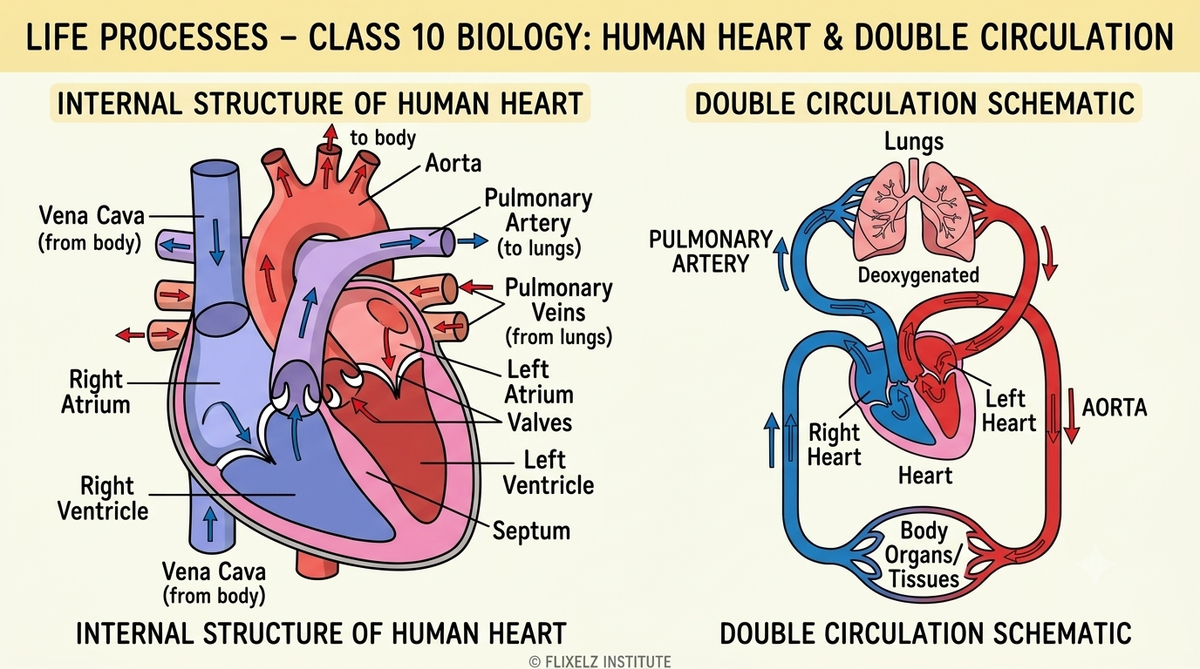
5.4.1 Transportation in Human Beings
- Blood (Fluid connective tissue): Consists of fluid plasma (transports food, $\text{CO}_2$, and nitrogenous wastes in dissolved form, plus salts) and suspended cells, notably RBCs carrying oxygen via haemoglobin.
- Our Pump — The Human Heart (NCERT Fig. 5.10): Muscular organ roughly the size of our fist with four chambers (two upper atria, two lower ventricles) to keep oxygen-rich blood strictly separate from $\text{CO}_2$-rich blood.
- Left side (Oxygenated blood): Oxygen-rich blood from lungs enters the thin-walled left atrium (relaxes) $\to$ left atrium contracts while left ventricle relaxes $\to$ left ventricle contracts and pumps oxygenated blood to the entire body (via aorta).
- Right side (Deoxygenated blood): Deoxygenated blood from the body enters the right atrium (relaxes) $\to$ right atrium contracts and transfers blood to the right ventricle $\to$ right ventricle pumps it to the lungs for oxygenation.
- Ventricles vs. Atria: Ventricles have thicker muscular walls than atria because they must pump blood into various organs. Valves ensure blood does not flow backwards when atria or ventricles contract.
- Double Circulation & Heart Chambers across Vertebrates (NCERT Fig. 5.11):
- Birds & Mammals (4-chambered heart): Complete separation of oxygenated and deoxygenated blood provides a highly efficient oxygen supply needed for high energy to maintain a constant body temperature. Blood goes through the heart twice during each complete cycle — called double circulation.
- Amphibians & many Reptiles (3-chambered heart): Body temperature depends on the environment (lower energy needs), so they can tolerate some mixing of oxygenated and deoxygenated blood.
- Fishes (2-chambered heart): Blood is pumped to gills (oxygenated there) and passes directly to the rest of the body — blood passes through the heart only once per cycle (single circulation).
More to Know! — Blood Pressure & Hypertension
Blood pressure is the force exerted by blood against the wall of a vessel (much greater in arteries than veins). Pressure inside an artery during ventricular contraction is systolic pressure (normal $\approx \mathbf{120\text{ mm of Hg}}$), and during ventricular relaxation is diastolic pressure (normal $\approx \mathbf{80\text{ mm of Hg}}$). It is measured using a sphygmomanometer. High blood pressure (hypertension) is caused by constriction of arterioles, increasing resistance to blood flow and risking rupture of an artery and internal bleeding.
Blood Vessels, Platelets & Lymph
| Component | Structure & Function (Strictly NCERT) |
|---|---|
| Arteries | Carry blood away from the heart to organs. Since blood emerges under high pressure, arteries have thick, elastic walls and no valves. |
| Veins | Collect blood from different organs and bring it back to the heart. Blood is no longer under high pressure, so walls are thinner, and veins have valves to ensure blood flows in one direction only. |
| Capillaries | On reaching an organ/tissue, arteries divide into smallest vessels whose walls are one-cell thick, allowing exchange of materials between blood and surrounding cells. Capillaries then join to form veins. |
| Platelets | Blood cells that circulate around the body and plug leaks by helping clot the blood at points of injury, preventing loss of blood and drop in pumping pressure. |
| Lymph (Tissue Fluid) | Some plasma, proteins, and blood cells escape through capillary wall pores into intercellular spaces to form lymph—colourless and containing less protein than plasma. Lymph drains into lymphatic capillaries $\to$ lymph vessels $\to$ larger veins. It carries digested and absorbed fat from the intestine and drains excess fluid from extracellular space back into the blood. |
5.4.2 Transportation in Plants
Plants do not move and have a large proportion of dead cells in many tissues, so they have low energy needs and use relatively slow transport systems—though distances can be very large in tall trees. Two independent conducting pathways exist:
- Xylem — Transport of Water & Minerals (Unidirectional, Upward):
- Vessels and tracheids of roots, stems, and leaves interconnect to form a continuous water-conducting channel.
- Root pressure: Root cells in contact with soil actively take up ions, creating a concentration difference between root and soil $\to$ water moves into roots from soil, steadily pushing a water column upwards. Important mainly at night or over short heights.
- Transpiration pull (Activity 5.8 & NCERT Fig. 5.12): Loss of water in vapour form from aerial parts of the plant is called transpiration. Evaporation of water from leaf cells creates a suction that pulls water up through xylem vessels from the roots—this is the major driving force during the day when stomata are open. Transpiration also helps in temperature regulation.
- Phloem — Transport of Food & Other Substances (Translocation — Bidirectional):
- Transport of soluble products of photosynthesis (plus amino acids and other substances) from leaves to storage organs (roots, fruits, seeds) and growing organs is called translocation.
- Takes place in sieve tubes with the help of adjacent companion cells in both upward and downward directions.
- Energy-dependent (ATP) mechanism: Unlike physical forces in xylem, translocation in phloem uses energy from ATP. Loading material like sucrose into phloem tissue increases the osmotic pressure of the tissue, causing water to move into it. This pressure moves material in phloem to tissues having less pressure according to plant needs (e.g., in spring, sugar stored in roots/stems moves to buds needing energy to grow).
5.5 Excretion
The biological process involved in the removal of harmful metabolic wastes (especially nitrogenous materials) from the body is called excretion. Unicellular organisms remove wastes by simple diffusion into surrounding water; complex multicellular organisms use specialised organs.
5.5.1 Excretion in Human Beings (NCERT Figs. 5.13 & 5.14)
- Purpose of making urine: Just as $\text{CO}_2$ is removed from blood in the lungs, nitrogenous wastes such as urea or uric acid are removed from blood in the kidneys.
- Nephron (Basic Filtration Unit): Each kidney has large numbers of filtration units called nephrons packed close together. Each nephron consists of a cluster of very thin-walled blood capillaries (glomerulus) associated with the cup-shaped end of a coiled tube called Bowman's capsule, leading into a tubular part and collecting duct.
- Selective Reabsorption: As initial filtrate flows along the tubule, useful substances—glucose, amino acids, salts, and a major amount of water—are selectively re-absorbed. The amount of water re-absorbed depends on: (1) how much excess water is present in the body, and (2) how much dissolved waste needs to be excreted.
- Filtrate vs. Urine volume: In a healthy adult, initial filtrate in the kidneys is about $180\text{ L}$ daily, yet actual urine excreted is only $1$–$2\text{ litres}$ a day because the remaining filtrate is re-absorbed in the kidney tubules.
More to Know! — Artificial Kidney (Hemodialysis) & Organ Donation
- Artificial Kidney (Hemodialysis): If kidneys fail due to infection, injury, or restricted blood flow, poisonous wastes accumulate. An artificial kidney contains tubes with a semi-permeable lining suspended in a tank of dialysing fluid having the same osmotic pressure as blood, but devoid of nitrogenous wastes. Patient's blood passes through these tubes; waste products diffuse into the dialysing fluid, and purified blood is pumped back. Key difference from real kidney: There is no re-absorption in hemodialysis.
- Organ Donation (Think it over!): Organs/tissues (cornea, kidneys, heart, liver, pancreas, lungs, intestines, bone marrow) can be donated after death—or a living donor can donate one kidney, part of a liver, or a lung—to save people suffering from organ failure.
5.5.2 Excretion in Plants
- Oxygen itself can be thought of as a waste product generated during photosynthesis (diffuses out through stomata).
- Excess water is removed by transpiration.
- Many tissues consist of dead cells, and plants can even lose parts such as leaves where waste products have accumulated.
- Many plant waste products are stored in cellular vacuoles.
- Other waste products are stored as resins and gums, especially in old xylem.
- Plants also excrete some waste substances directly into the soil around them.
Quick NCERT Revision Numbers & Exam Trap Buster
| NCERT Fact / Quantity | Exact Value / Rule to Remember |
|---|---|
| Energy released on ATP hydrolysis | $30.5\text{ kJ/mol}$ |
| Human Alveolar Surface Area | $\approx 80\text{ m}^2$ (diffusion alone would take 3 years from lungs to toes) |
| Normal Human Blood Pressure | Systolic $\approx 120\text{ mm Hg}$ / Diastolic $\approx 80\text{ mm Hg}$ (Sphygmomanometer) |
| Kidney Daily Filtrate vs. Urine | $\approx 180\text{ L/day}$ initial filtrate $\to$ $1$–$2\text{ L/day}$ urine excreted |
| Heart Chambers | Fishes: 2 (single circulation) · Amphibians/Reptiles: 3 · Birds/Mammals: 4 (double circulation) |
Don't Confuse! (Top CBSE Exam Traps)
- Bile juice has NO enzymes: Never write "bile enzyme"! Bile only makes food alkaline and emulsifies fats physically into smaller globules.
- Xylem vs. Phloem: Xylem moves water/minerals upward only using physical forces (root pressure + transpiration pull); Phloem moves food both upward & downward using ATP energy.
- Real Kidney vs. Artificial Kidney (Dialysis): Real kidneys perform selective re-absorption; an artificial kidney performs no re-absorption.
- First step of ALL respiration: Glucose (6-C) $\to$ Pyruvate (3-C) ALWAYS happens in the cytoplasm (both aerobic and anaerobic); only aerobic breakdown of pyruvate occurs in mitochondria.